Most SaaS outsourcing arrangements fail for the same reason: the client did not know how to evaluate the partner before signing, and the partner did not understand the product well enough to ask the right questions.
This guide covers how to decide whether to outsource SaaS development, how to find and vet a partner, how to structure the engagement, and how to manage it once it is running.
For the context of when outsourcing makes sense versus hiring a freelancer, see the agency vs freelancer comparison for SaaS MVPs.
What Is SaaS Development Outsourcing?
Outsourcing SaaS development means delegating some or all of your product's technical development to an external team — an agency, a specialist freelancer, or an offshore development firm. The external team delivers defined outputs (a working product, specific features, or ongoing maintenance) in exchange for a fee.
This is different from hiring: outsourced teams are not employees. They have their own processes, tools, and (often) other clients. Managing them requires a different approach than managing an internal team.
When outsourcing works, it accelerates development and gives you access to skills that would take months to hire in-house. When it fails, you end up with a codebase you do not own, a product that does not match specs, and months of rework.
The difference is almost always in how the engagement was set up, not how talented the external team was.
When Outsourcing SaaS Development Makes Sense

Outsource when:
- You are a non-technical founder and need to ship a product to validate an idea
- You have a defined scope and need to move faster than you can hire
- You need a specific skill (e.g., mobile development, complex data pipelines) that is not worth hiring full-time for
- Your internal team is at capacity and you need parallel development
Do not outsource when:
- You cannot clearly describe what you want to build
- You have no way to evaluate the quality of the output (no technical co-founder, no advisor, no CTO)
- Your core competitive advantage is the product itself and you cannot afford to share it
The agency vs freelancer comparison covers the full decision matrix including budget ranges and timeline expectations.
How to Vet an Outsourcing Partner

Most vetting processes focus on the wrong things: portfolio aesthetics, company size, and hourly rates. These matter less than:
Technical depth in your specific stack. If you are building a Next.js + Supabase SaaS, ask what projects they have shipped on that stack. Ask to see the code. A strong partner will not object.
How they handle ambiguity. Give them an underspecified requirement and watch what questions they ask. Good partners ask about the user's goal. Bad partners ask about pixel measurements.
Communication frequency and format. Ask how they structure weekly updates. "We'll send you a Loom every Friday with a demo and a written summary of blockers" is a real answer. "We stay in touch" is not.
References from relevant clients. Ask for a reference from a client whose product is similar to yours in scope and complexity. Then actually call the reference and ask: "What did they get wrong and how did they handle it?"

Red flags:
- They give you a fixed-price quote before asking detailed questions
- They cannot explain how they would approach your architecture
- Their previous clients are not willing to be references
- They push back on code review access or code ownership clauses
Structuring the Engagement
The contract matters less than the working structure, but both matter. Cover these in the contract:
IP ownership: all code, designs, and assets must be assigned to you upon payment. Not licensed to you — assigned. This is non-negotiable.
Code repository access: you must have admin access to the Git repository from day one. Not "access at the end of the project."
Deliverable definitions: what does "done" mean for each milestone? "The login flow is complete" is not a deliverable. "User can register with email, log in, reset password, and access their dashboard" is a deliverable.
Payment structure: tie payments to deliverables, not to time. A 30% deposit on contract signing, 40% on staging delivery, 30% on production deployment and acceptance is a standard structure.
Termination clause: you must be able to exit the engagement with 2 weeks notice and retain all work completed to that point. If a partner will not agree to this, that is a signal.
What SaaS Development Services Actually Include
Good outsourcing partners deliver more than code. A complete SaaS development engagement covers:
Architecture design: database schema, API design, auth pattern, multi-tenancy approach. This should happen before any code is written.
UI/UX design: wireframes, design system, responsive layouts. If the partner does not do design, you need a separate designer or you need to provide detailed mockups.
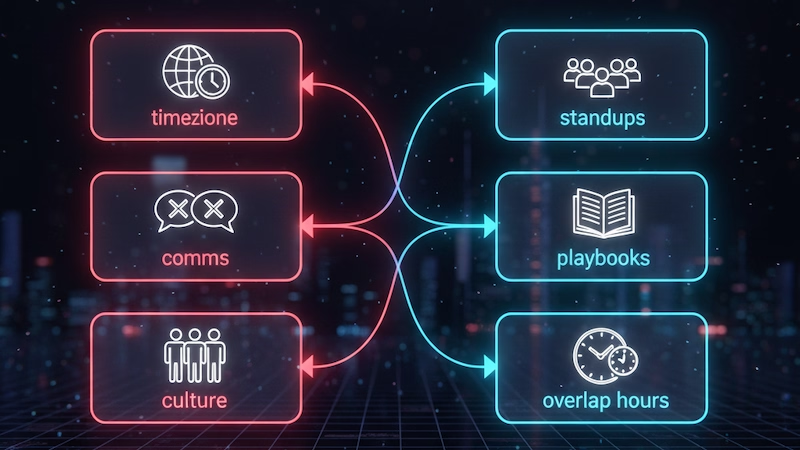
Front-end and back-end development: the actual product.
Testing: automated tests for auth, billing, and core workflows. Manual QA for everything else.
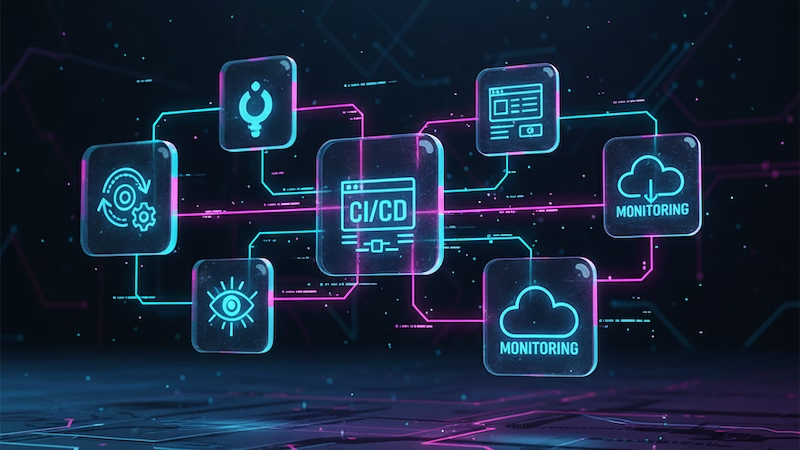
Deployment setup: CI/CD pipeline, staging environment, production environment, monitoring.
Handover documentation: how to run the project locally, how to deploy, where credentials are stored, how the data model works. Without this, you are dependent on the partner forever.
Managing the Outsourcing Relationship
The most common failure mode in outsourced projects is the client disappearing for three weeks and then being surprised by what was built. Your job as the client is to be available.
Structure that works:
Daily async updates: a short written Slack message or email from the partner: what was done today, what is next, what is blocked. Takes 5 minutes to write and keeps you informed without meetings.
Weekly demo: 30-minute video call where the partner demos the latest working build. You give feedback in the call. Not in a document two days later.
Biweekly retrospective: what is working, what is not, what needs to change. Keep this short and honest.
You review every PR or at minimum every major feature branch. If you are non-technical, have a technical advisor do this. No exceptions.
Key tools: Linear or Jira for task tracking, GitHub for code, Slack for async communication, Loom for async demos.
Security, Data Protection, and Compliance
SaaS products handle customer data. The external team will have access to your database, your environment variables, and potentially your customers' personal information.
Minimum requirements:
- Never share production database credentials with the development team. Use a staging environment with anonymised or synthetic data.
- Use secrets management (Vercel environment variables, AWS Secrets Manager) rather than secrets in code or Slack messages.
- Require the partner to pass a security review or penetration test before launch for any product handling sensitive data (health, finance, legal).
- GDPR compliance is not optional if you serve EU customers. The partner should be familiar with the requirements — if they are not, factor in the cost of a GDPR review.
Important aspects of compliance:
- Regular security audits and assessments
- Adherence to international data protection laws
- End-to-end encryption for data in transit and at rest
- Clear policies on data access and storage
Common Challenges and How to Handle Them
Scope creep: every change request that was not in the original spec will cost extra time and money. Maintain a change log. Agree on scope changes in writing before implementation begins.
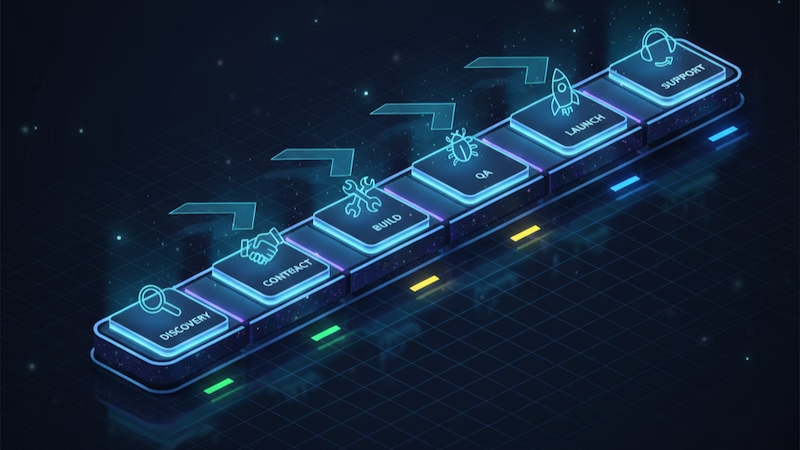
Communication gaps: time zone differences compound ambiguity. Prefer written communication over verbal for anything decision-related. A Loom video explaining a requirement is better than a call that leaves no record.
Quality drift: without code review, quality degrades over time. Review code at every milestone. Address technical debt before it compounds.
Vendor lock-in: if only the outsourcing partner can deploy or understand the codebase, you have a problem. Insist on standard tooling, documented architecture, and deploy automation from the start.
Tools and Technologies

Standard tooling for a well-run outsourced SaaS project:
| Category | Tool | |---|---| | Version control | GitHub | | Task management | Linear or Jira | | Communication | Slack | | Async demos | Loom | | CI/CD | GitHub Actions | | Monitoring | Sentry + UptimeRobot | | Deployment | Vercel (frontend), Supabase (backend) |
Insist on this stack or equivalent. Partners who use proprietary tooling you do not control are creating dependency by design.
What Good Outsourcing Looks Like in Practice
A startup with a non-technical founder outsources their SaaS MVP to a two-person development team. The engagement is structured with weekly demos, biweekly check-ins, and milestone-based payments. The client reviews every major feature in the staging environment before it moves to production.
At week 8, the partner surfaces an architectural issue: the original approach to multi-tenancy will not scale beyond 100 tenants without a schema migration. They propose a fix. The client approves it. The issue is resolved in week 9, not discovered post-launch.
At launch, the client has full code ownership, a documented deployment process, and a product that 8 beta users have been using for three weeks.

Key success factors: clear spec, milestone payments, weekly demos, code review at every step, and a partner who communicated problems instead of hiding them.
Summary
Outsourcing SaaS development works when you know what you want to build, you have a way to evaluate the output, and you structure the engagement to give you control rather than dependency.
The three things that matter most: IP ownership in the contract, code access from day one, and weekly demos tied to milestone payments.
If you are evaluating whether to outsource or hire a freelancer, or if you want to talk through what a well-structured engagement looks like for your specific product, start a chat.