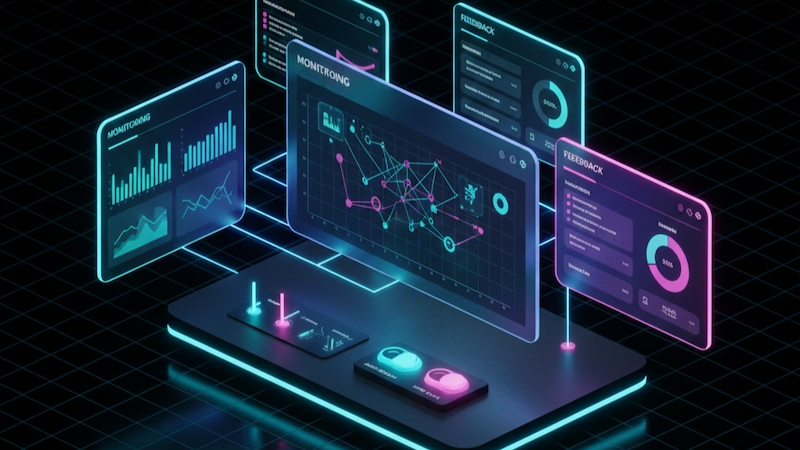
The SaaS product lifecycle is not a theory — it is a repeating loop. You build, ship, learn, and improve. The teams that do this well compound their advantages over time. The ones that treat each phase as a one-time task end up with stagnant products and rising churn.
This post covers each phase of the lifecycle practically: what to do, what to avoid, and what signals tell you when to move to the next phase.
What Is the SaaS Product Lifecycle?
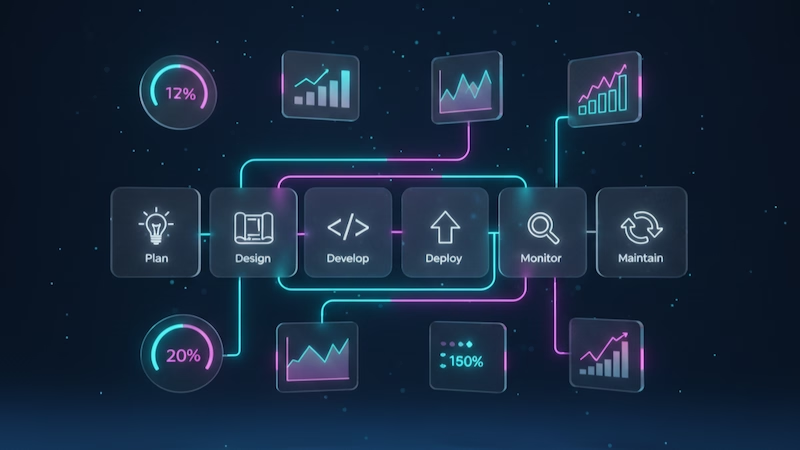
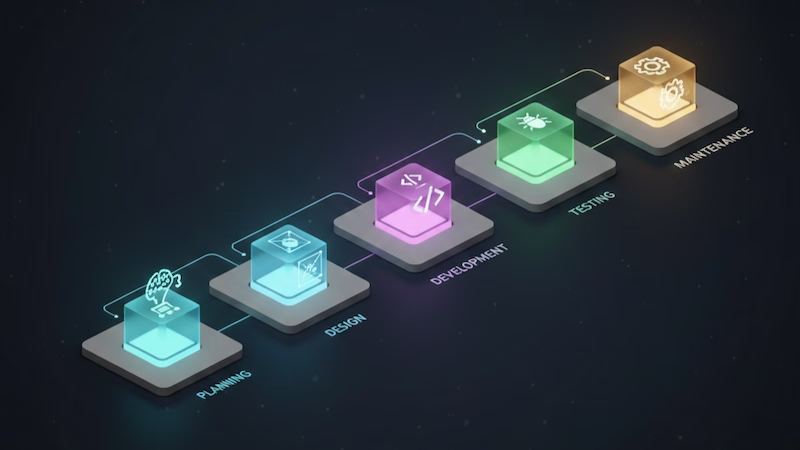
The SaaS lifecycle has six phases that repeat indefinitely, not just at launch:
- Planning — defining the problem, ICP, and core features
- Design — information architecture, UX flows, visual design
- Development — building the product
- Testing — functional, integration, performance, security
- Deployment — shipping to production
- Maintenance and iteration — monitoring, feedback, and improvement
Unlike traditional software with a defined "done" state, SaaS products are never finished. Version 1.0 ships, and version 1.1 is already being planned based on what real users do with 1.0.
Phase 1: Planning
Good planning answers three questions before a single line of code is written:
Who is the user? Not "small businesses" — a specific person with a specific job title in a specific industry with a specific problem. The more specific, the better the product will fit.
What is the core workflow? The one thing your product enables that the user cannot do as well without it. Every other feature is secondary until this one works perfectly.
What does success look like in 90 days? A concrete metric: 10 paying customers, €2,000 MRR, 15% trial-to-paid conversion. Without a target, you cannot tell if the plan worked.
For B2B SaaS products planning multi-tenant architecture, the multi-tenant SaaS guide covers the three architectural patterns and when to use each. Make this decision at planning time — retrofitting it later is expensive.
Phase 2: Design
Design in SaaS is not about aesthetics. It is about reducing friction between the user and the core workflow.
The most common design mistake in early-stage SaaS: building for hypothetical advanced users instead of the onboarding journey of a new user who has never seen the product before.
Design the onboarding first. Walk through the exact steps a new user takes from sign-up to completing the core workflow for the first time. Every unnecessary step in that journey is lost activation.
Key design principles for SaaS:
- New users should reach "first value" in under 10 minutes
- The primary navigation should have 5 items or fewer
- Error messages should tell users what to do, not just what went wrong
- Empty states should guide users toward their first action, not just show a blank screen
Phase 3: Development

Build in the order that makes business sense, not the order that makes technical sense.
The technically logical order is: database → API → frontend. The business-logical order is: auth → core workflow → billing → everything else.
Billing often gets deferred to "after we validate." This is wrong. Billing is part of validation. If you cannot charge someone for your product, you have not validated it. Integrate Stripe before your first external demo.
Development anti-patterns to avoid:
- Premature optimisation: do not build for 100,000 users when you have 0. Solve for your first 100 users and optimise when data tells you to.
- Feature creep: every feature added before launch delays launch. Features can be added post-validation. Launch cannot.
- Over-engineering the data model: start simple. Normalise and extend when real data patterns emerge.
Phase 4: Testing
Testing at MVP stage should be proportional to risk, not exhaustive.
Test these things thoroughly:
- Authentication flows: broken auth means users cannot access the product
- Billing integration: billing bugs directly cost money and trust
- Core workflow: the one thing your product does must work flawlessly
- Data isolation (for multi-tenant products): one tenant must never see another tenant's data
Test these things lightly at MVP stage:
- Edge cases in secondary features
- Performance under high load
- Browser compatibility beyond Chrome + Safari
Automate tests for auth, billing, and the core workflow only. Everything else is over-investment at MVP stage.
Phase 5: Deployment

For modern SaaS on Next.js + Supabase + Vercel, deployment is straightforward:
- Vercel handles frontend deployments automatically on push to main
- Supabase migrations run via the Supabase CLI
- Environment variables managed in Vercel's dashboard
Set up these three things before any user touches the product:
- Error monitoring (Sentry free tier): you need to know when something breaks before users tell you
- Uptime monitoring (UptimeRobot free tier): you need to know when the product is down
- Database backups: Supabase handles this automatically, but verify the policy
Post-deployment, set up feature flags for any incomplete or experimental functionality. Ship incrementally to a subset of users before rolling out broadly.
Phase 6: Maintenance and Lifecycle Management
This is where most teams underinvest. The product is live, the pressure to ship new features is high, and ongoing maintenance feels like overhead.
It is not. Poor maintenance directly causes churn.
Performance Monitoring
Track these metrics continuously after launch:
- API response times: p95 latency above 500ms starts causing user frustration
- Error rates: any error rate above 1% for the core workflow needs immediate attention
- Database query times: slow queries compound under load
Use Supabase's built-in query analyser to identify slow queries. Most performance issues in early-stage SaaS come from missing indexes, not architectural problems.
User Communication
Proactive communication reduces churn. When you ship improvements:
- Send a changelog email to all active users
- Highlight changes to the core workflow specifically
- Make it easy for users to respond directly (reply to the changelog email)
The founders who maintain direct email communication with their first 100 customers build stickier products than those who route everything through a support ticket system.
Common Challenges in SaaS Development
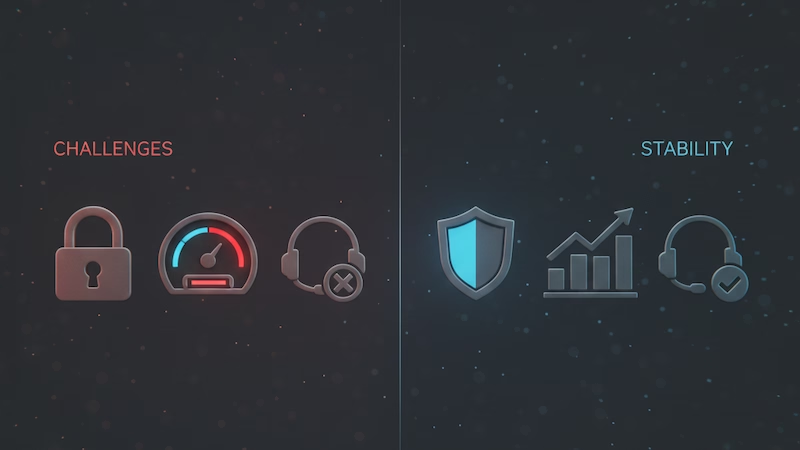
Security and data privacy: multi-tenant SaaS products handle data from multiple customers on shared infrastructure. Row-level security in Postgres (built into Supabase) is the correct default for most B2B SaaS. It enforces tenant isolation at the database level, not just the application level.
Availability: SaaS products are expected to be available 24/7. Vercel and Supabase both have 99.9%+ uptime SLAs on paid plans. On free tiers, factor in downtime risk. For production products serving paying customers, upgrade to paid infrastructure.
Customer support at scale: the support model that works for your first 10 customers (direct email) does not scale to 100. Build a help documentation base before you need it. Intercom or Crisp for in-app support. A public changelog. These reduce support volume significantly.
Best Practices for Long-Term SaaS Success
Ship weekly, communicate monthly. Users should see the product improving. A monthly update email keeps active users engaged and reduces passive churn.
Measure everything that matters, ignore everything that does not. At early stage, the metrics that matter are: trial-to-paid conversion, monthly churn, and time to first value. Everything else is noise until you hit €10k MRR.
Talk to churned users. This is the highest-value activity most founders skip. Every churned user is a direct signal about a product gap. One conversation can surface a problem that 10 churned users had silently.
Do not add features when the core workflow is broken. If users struggle to complete the primary task, adding a secondary feature does not fix churn — it adds complexity to a broken experience.
The Future: AI, Automation, and What Changes in 2025
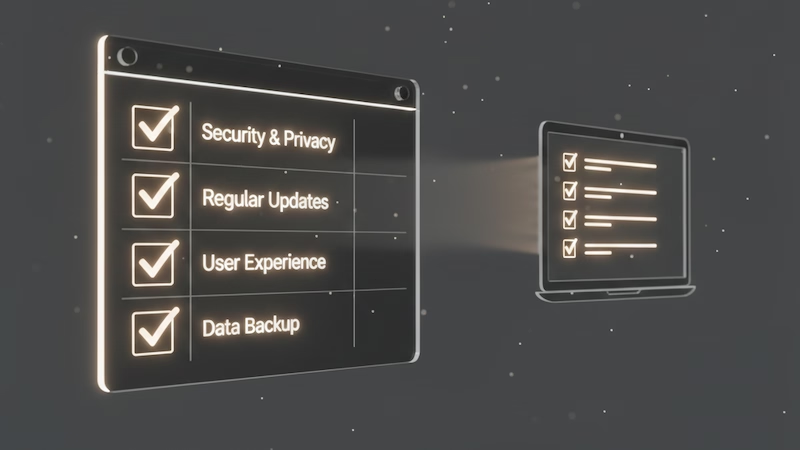
Three trends reshaping the SaaS product lifecycle in 2025:
AI-augmented workflows: the most successful SaaS products are embedding AI into the core workflow, not adding it as a feature. Drafting, analysis, and decision support inside the product's primary use case.
Faster iteration cycles: with Vercel, Supabase, and AI-assisted development, the time from user feedback to shipped feature is compressing. Teams that can ship in days instead of weeks have a structural advantage.
Stricter data regulation: GDPR enforcement is increasing. GDPR compliance, data residency options, and transparent privacy practices are moving from differentiators to requirements for enterprise customers.
Summary
The SaaS product lifecycle is a loop, not a line. The teams that win are the ones that iterate fastest based on real user data, maintain the core workflow obsessively, and communicate proactively with their customers.
If you are building a SaaS product and want technical guidance on architecture, stack selection, or scaling, start a chat — I work with SaaS founders from early planning through to production.