Building a SaaS MVP without a clear strategy is the fastest way to waste six months and €30,000. This post covers the framework I use with early-stage SaaS founders: validating the market, scoping the build, selecting the stack, structuring the team, and setting the KPIs that actually predict product-market fit.
For a foundational definition, see what a SaaS MVP is and how long it realistically takes to build one.
What is a SaaS MVP and Why Does It Matter?
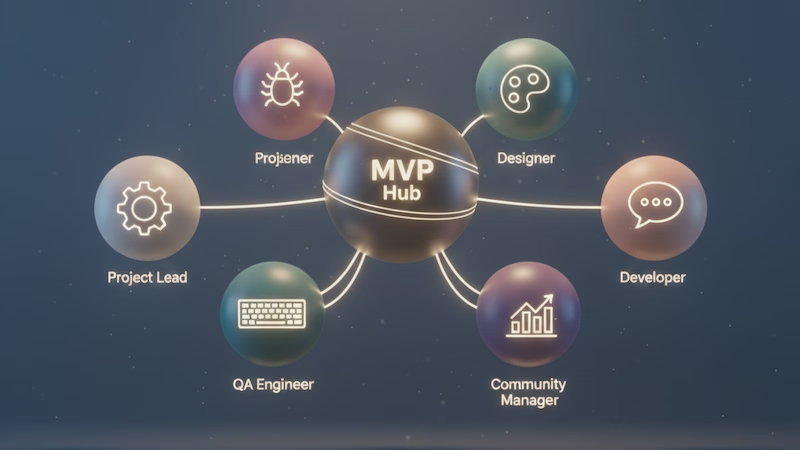
A SaaS MVP is the minimum version of your product that delivers enough value for one specific customer to pay for it. Not a demo. Not a prototype. A working product with real billing, real auth, and a real core workflow.
The goal is not to impress investors or win design awards. The goal is to generate a signal: does this solve a real problem well enough that someone hands over money?
Every feature not in service of that goal is waste.

Key benefits of the MVP approach:
- Validate the problem before building the full solution
- Reduce financial risk by testing assumptions early
- Get real user feedback instead of hypothetical research
- Reach first revenue faster, which funds further development
For budget planning, see the SaaS MVP cost breakdown.
Market Validation: Do the Work Before You Write Code

The most expensive mistake in SaaS is building something nobody wants to pay for. Market validation is not reading industry reports — it is talking to 10 real potential customers.
Ask them:
- What do you currently use for this problem?
- What breaks about that solution?
- How much does this problem cost you per month?
If they cannot quantify the cost of the problem, it is probably not painful enough to pay to fix. If they give you a number, you have the foundation for your pricing.
Identify your ICP (Ideal Customer Profile) before defining features. A product for "small businesses" is not a product. A product for "independent physiotherapy clinics with 2–5 practitioners" is a product.
Defining Features: Cut Until It Hurts
Write down every feature you think the product needs. Then cut the list in half. Then cut it again.
What survives should be the single core workflow that solves the stated problem. Everything else is post-validation scope.
Standard MVP inclusion checklist:
- Authentication (email + password, nothing else)
- The core workflow (the one thing your product does)
- Basic data management for that workflow
- Stripe billing (even before launch — integrate it before your first demo)
- Email notifications (one trigger, not a full notification system)
Standard MVP exclusion list:
- Admin dashboards
- Mobile app
- Social login
- Usage analytics (use a third-party tool instead)
- Multi-language support
- Notification preferences
Every item on the exclusion list can ship post-validation when real users tell you they need it.
Building the Product Roadmap
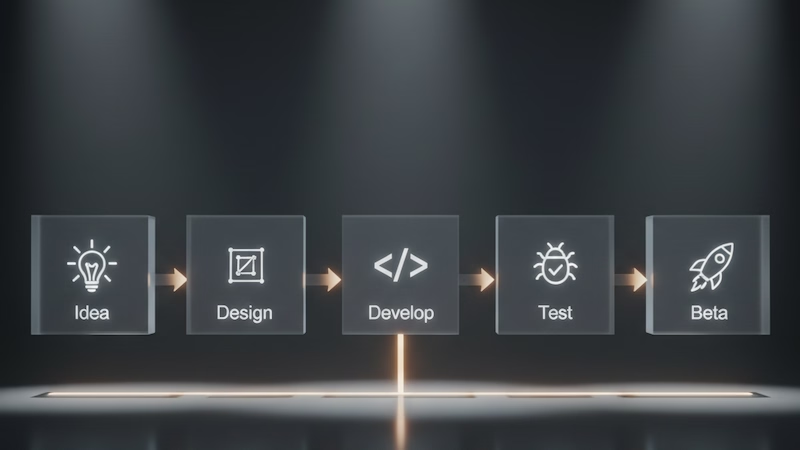
A roadmap at MVP stage is simple: what are you building in weeks 1–4, weeks 5–8, and weeks 9–12?
Break it down by milestone, not by feature list:
Weeks 1–4: Auth + core data model + basic UI scaffolding Weeks 5–8: Core workflow end-to-end + Stripe billing + email notifications Weeks 9–12: Polish, bug fixing, beta users, iteration
The roadmap should be revisable weekly based on what you learn. If you are three weeks in and a beta user shows you the core workflow is wrong, that is valuable information — not a failure. Adjust.
Choosing the Tech Stack
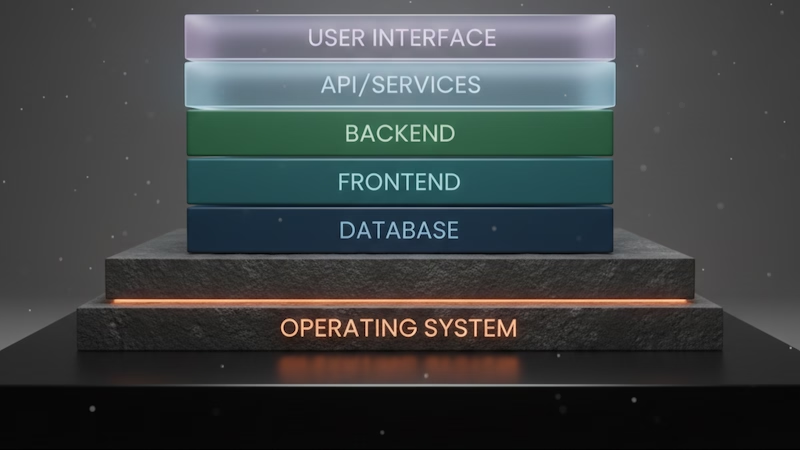
For most B2B SaaS MVPs in 2025, this stack covers 90% of use cases:
- Frontend: Next.js (App Router) + TypeScript + TailwindCSS
- Backend/DB: Supabase (Postgres + auth + storage + edge functions)
- Payments: Stripe
- Email: Resend
- Hosting: Vercel (frontend) + Supabase (backend)
This is a boring stack. That is a feature, not a limitation. Boring stacks have large communities, extensive documentation, and predictable behaviour. At MVP stage, developer velocity matters more than architectural sophistication.
Do not build a microservices architecture for an MVP. One monolith, one database, one deployment. Complexity can wait until you have paying customers who demand it.
Team Structure
The ideal MVP team is 1–3 people. Larger teams introduce communication overhead that slows shipping.
For a solo technical founder: you can build the MVP yourself. It will take longer but you control every decision.
For a technical + business co-founder pair: one builds, one sells. Both validate. This is the fastest path to first revenue.
For a non-technical founder: you need one strong full-stack developer who has built SaaS products before. Not a generalist agency. Someone who has done auth, billing, and multi-tenant data models before.
See agency vs freelancer for SaaS MVP for how to choose between hiring an agency and a freelancer.
Development Process
Build in this order every time:
- Database schema + auth
- Core workflow (the thing your product actually does)
- Stripe billing (before any external demos)
- Email notifications
- UI polish
The most common mistake is starting with UI and working backwards. This produces beautiful products with broken business logic. Start with data and work forwards.
Write tests for the billing integration and the core workflow only. Skip tests for everything else at MVP stage — you will rewrite it anyway based on feedback.
Validation and Testing
Before wider launch, test with 5–10 hand-picked beta users who match your ICP exactly. Give them full access in exchange for a 30-minute feedback session.
Watch them use the product without explaining how it works. Where they get confused is where your onboarding is broken. Where they stop and ask questions is where your UX is failing.
Do not fix everything between sessions. Identify the 1–2 issues that most block completion of the core workflow and fix those first.
Launch Strategy
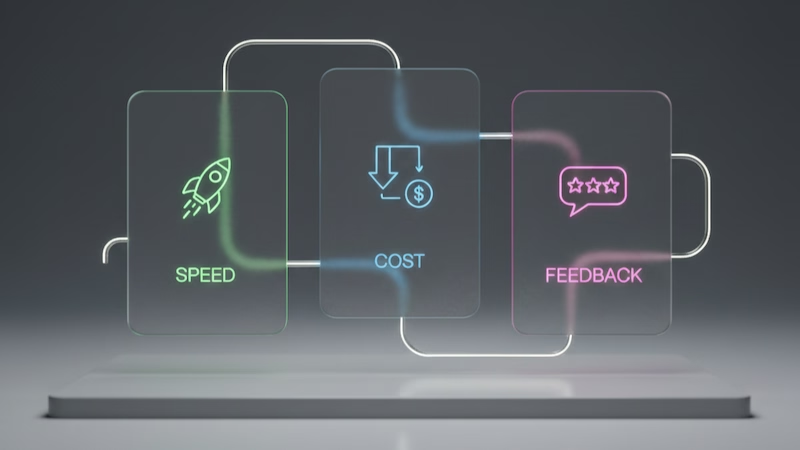
A SaaS MVP launch is not a Product Hunt post. It is a direct outreach campaign to the 20–50 people in your ICP who you have already identified.
Email or LinkedIn message each of them personally. Mention a specific pain point you know they have. Offer a call to show them what you built.
Convert the interested ones to paid plans immediately — even at a discount. "Free for early users" is a mistake. Set a real price from day one.
Your goal at launch: 3 paying customers who use the product weekly. That is the signal that justifies continued development.
Feedback Collection
After launch, your two most important feedback sources are:
- Support conversations: every question a user asks is a gap in your product or documentation
- Churn conversations: every user who cancels should get a personal email asking why
Do not rely on surveys at MVP stage. Response rates are low and the answers are vague. Talk to users directly.
Set up a simple feedback channel — a shared Slack workspace or a direct email thread. Users who feel heard stay longer.
Measuring Success: The KPIs That Matter

At MVP stage, track these four metrics and nothing else:
Trial-to-paid conversion rate: percentage of trialists who become paying customers. Target: above 15%. Below 10% means the product is not solving the problem clearly enough, or you are attracting the wrong users.
Monthly churn rate: percentage of paying customers who cancel each month. Target: below 5%. Above 10% means the product is not delivering ongoing value.
Time to first value: how long it takes a new user to complete the core workflow for the first time. This should be under 10 minutes for most B2B SaaS products.
NPS (Net Promoter Score): ask users "how likely are you to recommend this to a colleague?" after their first 30 days. Anything above 30 at MVP stage is strong.
Iteration and Pivoting
Post-launch, you have three possible signals:
Strong signal: trial-to-paid conversion above 15%, churn below 5%, users completing core workflow. Keep building. Prioritise the features your paying customers ask for most.
Weak signal: some conversions, high churn. The problem is real but the product does not solve it well enough yet. Iterate on the core workflow based on feedback before adding new features.
No signal: very few trials, almost no conversions. Either the ICP is wrong, the problem is not painful enough, or the positioning is off. This is the pivot signal. Go back to customer conversations before writing more code.
Funding for a SaaS MVP

Most SaaS MVPs do not need external funding. A solo developer or small team can build a functional MVP for €15,000–€40,000 in development costs (or less if you are technical). That is well within bootstrapper range.
If you do seek investment, raise after you have paying customers — not before. An MVP with 10 paying customers at €99/month is infinitely more fundable than a prototype with zero revenue.
When presenting to investors: show your trial-to-paid conversion rate, monthly churn, and a roadmap to €10k MRR. Those three numbers tell the story.
Tools and Technology Reference

Quick reference for recommended tools by category:
| Category | Tool | Why | |---|---|---| | Frontend | Next.js | App Router + SSR + API routes in one | | Database | Supabase | Postgres + auth + storage + RLS | | Payments | Stripe | Industry standard, best docs | | Email | Resend | Simple API, excellent deliverability | | Analytics | PostHog | Self-hostable, event-based | | Error tracking | Sentry | Free tier covers MVP usage | | Hosting | Vercel | Zero-config Next.js deployment |
Summary
A successful SaaS MVP strategy comes down to three things: validate the problem before you build, build the minimum that proves value, and get paying customers before you are "ready."
The realistic MVP timeline from idea to first paying customer is 10–16 weeks for a focused two-person team. More time than that usually means the scope is too large.
If you want to talk through your specific product idea, get a build estimate, or need a technical partner for the MVP stage, start a chat.